


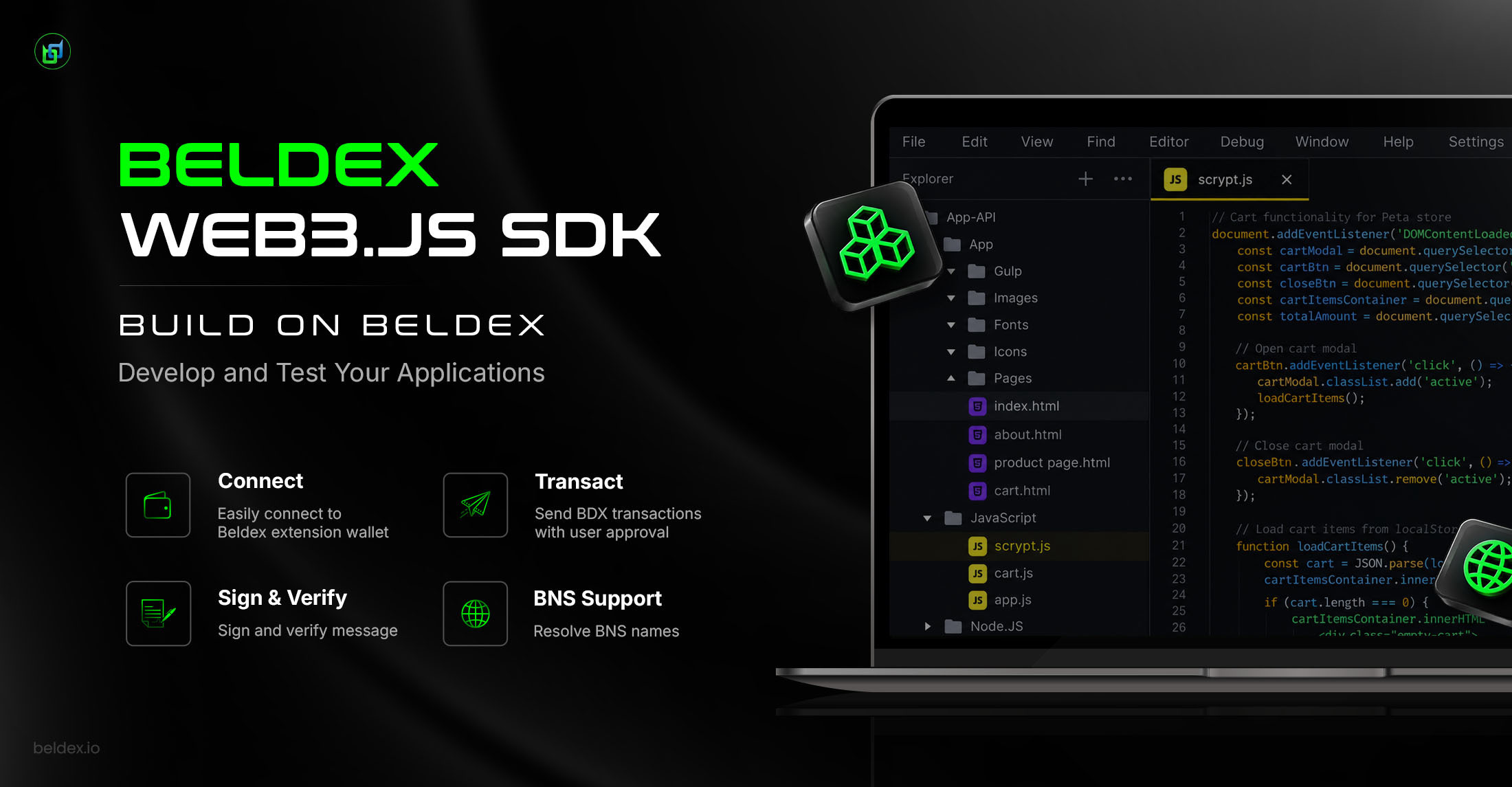
Beldex introduced its Web3JS SDK alongside Privacy Tokens on its testnet on October 6, 2026, giving developers the tools to build privacy-first applications on the Beldex network.
Available as a JavaScript package, the SDK enables developers to connect web applications to the Beldex Extension Wallet, interact with the network, and integrate Privacy Tokens into their applications.
With these tools now available on testnet, developers can begin experimenting with private payments, confidential digital assets, and applications where financial privacy is built into the underlying infrastructure.
Here’s how the Beldex Web3JS SDK works, how it fits into the ecosystem, and how developers can start building with it.
What Is the Beldex Web3JS SDK?
Beldex has developed an ecosystem of privacy-focused applications, including BChat for private messaging, BelNet for decentralized VPN services, Beldex Browser for browsing, Beldex Wallet for private transactions, and BNS for blockchain-based names.
With the introduction of Privacy Tokens and the Web3JS SDK on testnet, Beldex has extended its infrastructure to developers looking to build their own privacy-focused applications.
Privacy Tokens allow developers and projects to issue digital assets with privacy built into the network. Transaction details, including sender and receiver information, amounts, and balances, are protected from public visibility.
However, issuing a token is only one part of building an application. Developers also need a way for their applications to interact with users’ wallets and the Beldex network.
This is where the Beldex Web3JS SDK comes in.
The SDK is a JavaScript package, available on npm as @bdxi/web3js, that enables developers to integrate supported Beldex network and wallet functionality into web applications using familiar JavaScript development tools.
Instead of building wallet connectivity and network interactions from scratch, developers can use the SDK as an interface between their applications and the Beldex ecosystem.
How the Pieces Fit Together
Building privacy-first applications on Beldex involves three core components:
- Privacy Tokens: The asset layer that allows projects to issue and manage privacy-preserving digital assets on the Beldex network.
- Beldex Extension Wallet: The wallet interface through which users manage their BDX, Privacy Tokens, and supported transactions.
- Web3JS SDK: The developer interface that enables web applications to interact with the Beldex Extension Wallet and supported network functionality.
Together, these components provide the foundation for building applications that incorporate private digital assets without requiring developers to create their own privacy-focused blockchain.
Here’s how developers can get started on testnet.
Step 1: Set Up Your Beldex Extension Wallet
Install the Beldex Extension Wallet from the Chrome Web Store.
Once installed, create a new wallet or restore an existing wallet using your 25-word recovery seed.
The extension operates as a lightweight browser wallet, allowing users to interact with the Beldex network without downloading the entire blockchain.
Keep your recovery seed secure and never share it with anyone.
Note: When restoring an existing wallet, the extension may initially display a zero balance because of its synchronization behavior. Existing balances and historical transactions may not be immediately available through the extension.
Step 2: Switch to Testnet and Get Funds
To begin testing, open the wallet menu by clicking the three dots in the upper-right corner.
Navigate to Manage Network and select Testnet.
Once connected, a Testnet badge will appear in the wallet header.
Developers can obtain testnet BDX through the Beldex Testnet Faucet and explore the network through the Beldex Testnet Portal.
Testnet BDX has no monetary value and is intended for development and experimentation.
Step 3: Register Your Privacy Token
With the wallet connected to testnet and funded with testnet BDX, developers can register their own Privacy Tokens.
Open the wallet menu and select Register Token.
Enter the required token details, including:
- Token name and ticker
- Decimal precision
- Initial supply
- Maximum supply
Registering a Privacy Token currently requires 200 testnet BDX, distributed as follows:
Requirement
Amount
Collateral (locked for approximately six months) — 100 BDX
Burn amount — 50 BDX
Registration fee — 50 BDX
Total — 200 BDX
The 100 BDX collateral is automatically unlocked when the specified block height is reached, approximately six months after registration. The burn amount and registration fee are non-refundable.
Once registration is complete, the initial token supply is minted to the registering wallet.
Developers should copy and securely store the generated Privacy Token ID for future reference, as it may not remain visible in the extension wallet. Here’s a detailed guide on how to register your privacy token using the extension wallet.
Building Your Application with the Web3JS SDK
Once the wallet is configured and a Privacy Token has been registered, developers can begin integrating Beldex functionality into their web applications.
The Web3JS SDK can be installed through npm:
npm install @bdxi/web3js
The SDK provides an interface for applications to interact with the Beldex Extension Wallet and supported network functionality.
Through the SDK, developers can:
- Connect web applications to users’ Beldex Extension Wallets.
- Retrieve supported wallet and network information.
- Initiate supported transactions through wallet interactions.
- Integrate Privacy Tokens into application workflows.
- Build applications that use the privacy capabilities provided by the Beldex network.
Because Privacy Tokens use Beldex’s UTXO-based privacy architecture, developers can build on an existing privacy-preserving asset layer rather than implementing transaction privacy independently.
This allows development efforts to focus on application functionality and user experience while using the network’s underlying privacy capabilities.
What Can Developers Build?
The Web3JS SDK and Privacy Tokens provide a foundation for experimenting with different types of privacy-focused applications.
Some potential use cases include:
Private Payment Applications
Applications that allow users to transfer supported digital assets without publicly exposing transaction amounts and participant information.
Privacy-Preserving Swap Platforms
Platforms that explore asset exchange workflows while incorporating the confidentiality features of Beldex Privacy Tokens.
Confidential Rewards and Loyalty Programs
Applications that distribute and manage digital rewards without making individual token balances and transaction activity publicly visible.
Privacy-Focused DeFi Applications
Financial applications that explore how private digital assets can support new use cases as Beldex’s developer infrastructure expands.
Membership and Access Systems
Applications that use digital assets to represent membership, participation, or access rights while reducing unnecessary exposure of financial activity.
These are potential development directions rather than a list of applications already supported end to end. Their implementation will depend on the functionality available on testnet and future infrastructure developments.
What’s Next for Developers Building on Beldex?
Privacy Tokens and the Web3JS SDK have been available on the Beldex testnet since October 6, 2026, following the Proto testnet hard fork at block height 4,242,200.
The current testnet phase gives developers an opportunity to register Privacy Tokens, test wallet integrations, explore application workflows, and identify areas for improvement ahead of mainnet deployment.
Developers are encouraged to experiment with the available tools and share feedback on bugs, integration challenges, and potential improvements.
Funding Opportunities Through the Beldex Grants Program
Developers planning to build privacy-focused applications on Beldex can also explore funding opportunities through the Beldex Grants Program.
The $1 million program supports developers, startups, and teams building privacy-focused applications, tools, and infrastructure on the Beldex network.
Projects working with Privacy Tokens, developer tooling, payment applications, and other privacy-focused use cases can review the program’s eligibility requirements and submit proposals.
Learn more and apply: https://www.beldex.io/grants
Expanding the Developer Infrastructure
Beyond the current UTXO-based Privacy Token architecture, Beldex is working toward account-based addresses and a planned EVM-compatible sidechain.
These developments are intended to expand the types of applications developers can build while extending privacy-oriented capabilities across the ecosystem.
For now, the Web3JS SDK, Beldex Extension Wallet, and Privacy Tokens provide a starting point for developers interested in building and testing privacy-first applications.
Developers can explore the SDK, register Privacy Tokens, and begin building on the Beldex testnet today.
Developer Resources
- Web3JS SDK: https://www.npmjs.com/package/@bdxi/web3js
- Beldex Extension Wallet: https://chromewebstore.google.com/detail/beldex-wallet/onhnehjhhionmnbidajneakngpiefapa
- Beldex Testnet: https://testnet.beldex.dev/
- Testnet Faucet: https://faucet.beldex.dev/
- Beldex Grants Program: https://www.beldex.io/grants
 Listen

 back to blog