


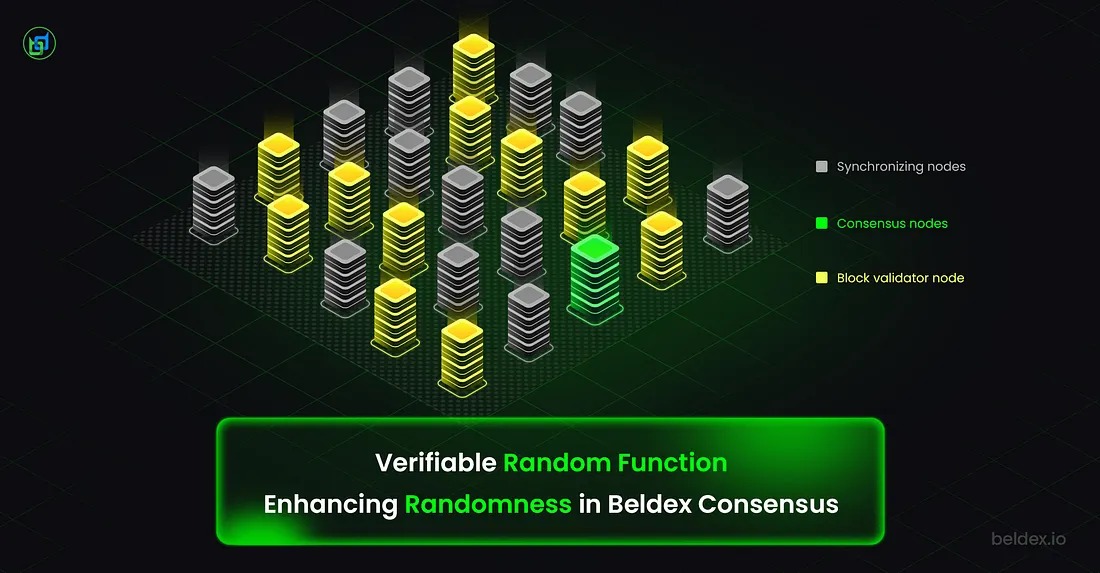
Learn more about Beldex’s proposed transition to the VRF consensus algorithm from the existing BeldexPOS consensus.
TL;DR
- VRF consensus optimizes the existing BeldexPOS consensus to introduce a fair and randomized selection of block leaders and validators.
- Instead of a fixed 11+1 setup, almost 2/3rd of validators can participate in consensus, making the network more decentralized, unpredictable, and secure.
- This reduces time to finality, distributes rewards equally, protects against 51% attacks, prevents bad actors’ collusion, and quantum threats.
- Already on the Beldex testnet, VRFs will soon strengthen the mainnet consensus.
What is VRF?
VRF stands for Verifiable Random Function. It’s a cryptographic function that takes several inputs and computes a pseudorandom output along with a proof that can be verified by anyone, without having to compute the actual output. It is sufficient if the verifier proves that the generated output is random.
Why VRFs?
Verifiable randomness is the benefit that VRF brings to blockchains.
Be it selecting validators in consensus, generating drops in play to earn games, or ensuring that there’s no predictability in certain decentralized smart contracts such as lottery systems, NFT minting, or randomized reward mechanisms.
VRF is fair, transparent and offers tamper-proof, immutable, verifiable random outputs.
Why Transition From the Existing Model?
While the current BeldexPoS model with 11 validators and 1 block producer ensures stability, it also introduces certain limitations:
- Predictability: A small, fixed validator set makes leader selection easier to anticipate.
- Large Stake: The low entry barrier was designed so that anyone can run a node. However, this results in a single party with sufficient capital holding a large stake within the network. While their stake prevents them from acting maliciously, the Beldex community members should hold the largest stake collectively, instead of a single entity or organization.
- Longer finality: Multiple handshake rounds and checkpoints are required for block confirmation.
VRFs overcome these limitations by expanding validator participation, eliminating predictability, and simplifying consensus finality.
How Will VRF Complement Beldex?
VRFs ensure unpredictability in Beldex consensus by picking validators and block producers at random, expanding the validator set from the current 11+1 to 2/3rds of the total number of validators, thereby enhancing security and resilience against DDoS, 51% takeover, man-in-the-middle attacks and even attacks from quantum computers.
When the validator selection is both random and verifiable, there’s no room for bias, collusion by bad actors, and consensus-round hijacking by validators that own a large number of masternodes in the network.
Anyone Can Run A Node
This reduces the entry barrier but also has the risk of a malicious actor with large enough resources to disrupt the normal functioning of the network.
While they are disincentivized from doing so, since the party with the majority stake would also stand to lose all their collateral if they were to act against the network, we would like to upgrade our systems such that they don’t have the opportunity to even think about it.
The recent Monero-Qubic saga has taught us that we need to anticipate the unexpected.
Reduces Time to Finality
A number of intermediary rounds in consensus are discarded, which provides quicker consensus finality. This not only speeds up transaction confirmations but also improves the overall efficiency of the network, enabling higher throughput and smoother user experience.
Fair Reward Mechanism
Even if Validators and Block Producers are selected at random, over time, rewards for all the validators will be distributed equally based on the Law of Large Numbers (LLN).
The Law of Large Numbers states that as an experiment is repeated n number of times over an extended period, the average result (sample mean of the n values) gradually aligns with the expected value, given that the trials are independent of each other.
Simply put, the more times you repeat an activity, your observed outcome gradually aligns with the actual average. For example, if you roll a fair die repeatedly, the average outcome will steadily approach 3.5, which is the true expected value.
This ensures fairness, removes bias in selection, and incentivizes wider participation without centralizing rewards among a small group of nodes.
How VRF Enhances Security?
- Sybil resistance: VRFs ensure that even if an attacker has set up multiple nodes, the randomized selection process limits their influence within the network.
- Quantum resilience: By using verifiable randomness, VRFs make it difficult for quantum computers to predict the selection of validators.
- Byzantine fault tolerance: Collusion attempts by multiple bad actors or hijacking strategies are neutralized as outputs can be verified by all the validators.
How VRF Works in Beldex?
VRF works in Beldex in the following way:
- While the existing BeldexPOS selects 11 validators and one block producer, in VRF, about 2/3rds of the nodes participate in consensus.
- For example, if there are 2000 nodes in the network, at most 666 nodes will participate in the consensus round.
- A random Threshold Value (TV) is assigned for the round, but the participating nodes are not aware of this value.
- Each node then generates a pseudorandom individual Output Value (OV) along with a proof of authenticity.
- Every node aspires to generate an output value (OV) that is always lesser than the threshold value (TV).
- The values and proof generated by the nodes are broadcast to the network.
- Every node cross-verifies the authenticity of the pseudorandom output generated by every other node using the proof they’ve submitted.
- The node that produced the lowest output value lesser than the threshold value is selected to be the block producer, while other nodes act as block validators.
- A quorum is formed and the block is generated. This process also simplifies finality, since it removes the need for multiple handshake rounds.
- The threshold value is dynamic, so a new value is generated for the next consensus round.
When is VRF Expected to Go Live on the Beldex Mainnet?
VRF is currently live on the Beldex testnet and is being actively tested by the team. While there isn’t an exact estimate on when VRFs are scheduled to go live, when they do, they will improve validator selection, increase security, reduce time to finality, and enhance fairness in reward distribution.
Stay tuned for more updates.
 Listen

 back to blog